





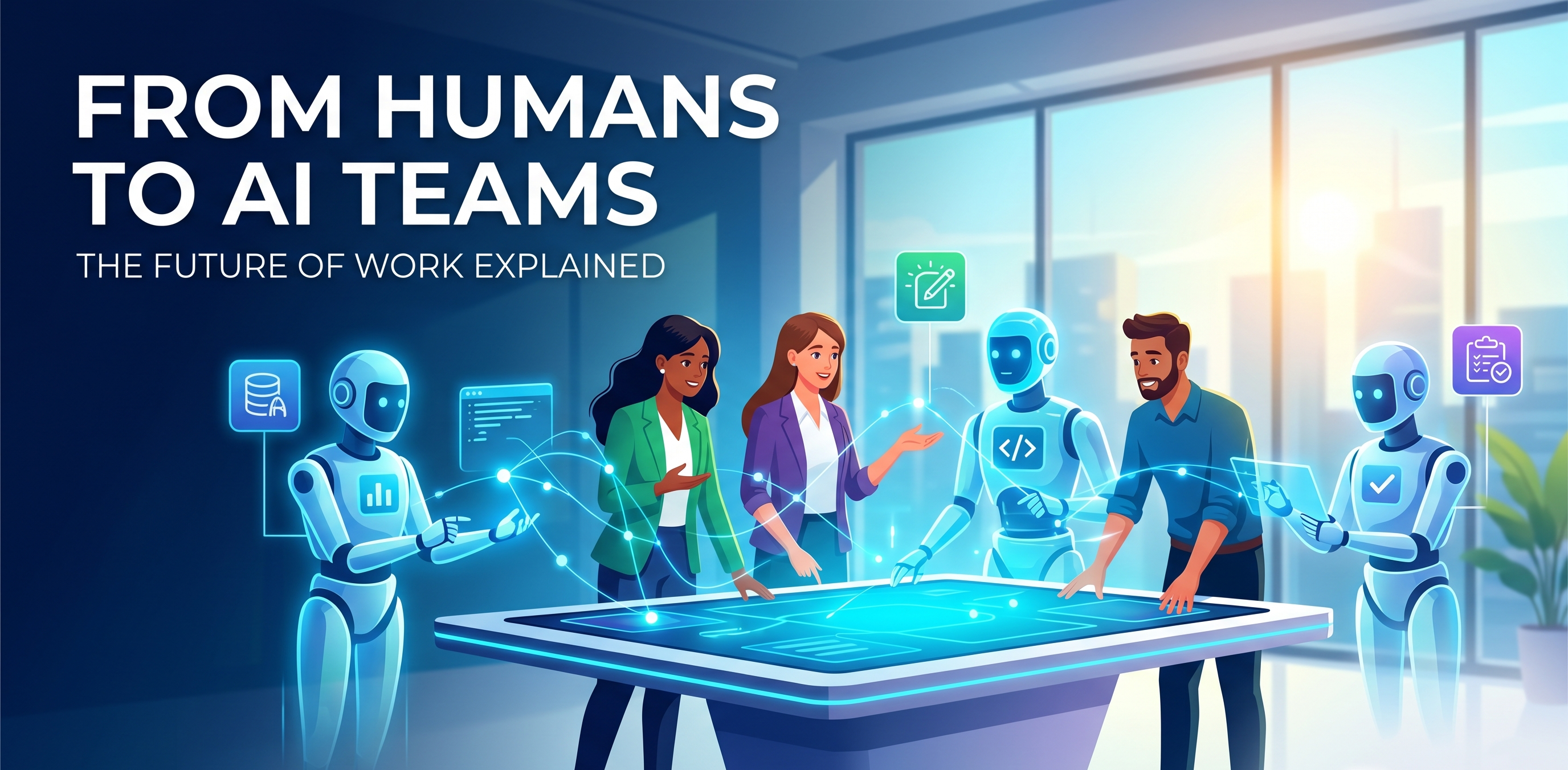
The definition of a "team" is undergoing the most radical shift since the Industrial Revolution. For decades, scaling a business meant hiring more people, optimizing human workflows, and managing cross-functional departments. Today, the landscape is shifting from humans using software to humans collaborating alongside software as teammates.
We are entering the era of AI teams—multi-agent ecosystems where autonomous AI components work in tandem with human leaders to execute complex business workflows. Here is a breakdown of what the future of work looks like and how it changes everything.
1. Beyond the Chatbot: The Rise of Autonomous Agents
To understand AI teams, we have to look past simple, reactive tools like ChatGPT. The future belongs to autonomous AI agents.
Unlike a chatbot that waits for a prompt, executes a single command, and stops, an autonomous agent is given a high-level goal. It can break that goal down into smaller tasks, write its own prompts, execute code, evaluate its own performance, and self-correct.
When you connect multiple specialized agents together, you get an AI team. For example:
- The Researcher Agent gathers raw data.
- The Analyst Agent structures it into actionable insights.
- The Content Agent drafts a report based on those insights.
- The QA Agent checks the report for factual errors before presenting it to a human supervisor.
2. The Hybrid Workspace: Human-AI Collaboration
AI teams are not built to replace human ingenuity; they are designed to amplify it. The most successful organizations will be those that master the Human-in-the-Loop (HITL) framework.
In this hybrid ecosystem, roles will shift dramatically:
- AI Handles: High-volume data processing, repetitive administrative workflows, initial drafting, technical debugging, and real-time monitoring.
- Humans Handle: Strategic vision, emotional intelligence, ethical decision-making, creative direction, and final quality control.
Instead of managing a team of twenty people to handle manual data entry, inventory tracking, or customer service tickets, a single human operator might manage an orchestrated network of AI agents that handle 90% of the heavy lifting.
3. How This Informs Modern Software Architecture
Building for this future requires a complete rethink of how business systems are designed. Legacy, monolithic software cannot communicate with autonomous agents effectively.
To prepare for AI-driven workflows, modern applications must prioritize:
- Robust API Layers: Software must be highly composable so that AI agents can effortlessly pull and push data across different modules (like connecting a billing system to an inventory database).
- Structured Data (JSON): Agents thrive on predictable data models. Architecting clean, fast, and light data payloads ensures that AI models can process business logic without latency.
- Advanced Performance Optimization: When autonomous agents start interacting with your software at scale, system load increases. Optimizing backend processing and maximizing bridge communication speed is critical to keeping operations seamless.
4. Preparing for the Shift
The transition to AI teams won't happen overnight, but the groundwork is being laid right now. Businesses looking to stay ahead should focus on digitizing their core processes today. Whether it's upgrading a legacy retail system or automating manual workflows, building a clean digital foundation is the prerequisite for onboarding your future AI teammates.
The future of work isn't a choice between humans or AI—it’s a powerful combination of both.